Table of Contents
- Key Takeaways
- Quick Verdict
- Product Overview & Specifications
- Real-World Performance & Feature Analysis
- Design & Build Quality
- Performance in Real Use
- Ease of Installation & Maintenance
- Durability & Reliability
- Pros & Cons
- Comparison & Alternatives
- Cheaper Alternative: Standard Elastomeric Couplings
- Premium Alternative: High-Performance Disc Couplings
- Buying Guide / Who Should Buy
- Best for Beginners
- Best for Professionals
- Not Recommended For
- FAQ
If you’ve spent any time around industrial machinery, you know that the humble coupling is the unsung hero of power transmission. It’s the critical link that either ensures smooth operation or becomes the source of endless maintenance headaches. The Falk Flexible Grid Coupling has been a staple in plants worldwide for decades, but does it still hold up against modern alternatives? More importantly, is it the right choice for your specific application?
Having installed and maintained these couplings in everything from wastewater treatment pumps to mining conveyor systems, I’ve seen what separates reliable power transmission from costly downtime. This isn’t about spec sheets—it’s about what actually matters when the machinery is running 24/7 under demanding conditions.
Key Takeaways
- Proven durability in harsh environments with excellent vibration damping that protects connected equipment
- Superior misalignment handling compared to many rigid couplings, but requires proper installation
- Grid replacement capability extends service life without replacing the entire coupling
- Not ideal for high-speed applications where balance-critical equipment demands zero vibration
- Requires periodic lubrication unlike some maintenance-free alternatives
Quick Verdict
Best for: Medium to heavy-duty industrial applications like pumps, compressors, conveyors, and crushers where shock absorption and misalignment compensation are critical.
Not ideal for: High-speed precision equipment, applications requiring zero maintenance, or situations with extreme parallel misalignment beyond design limits.
Core strengths: Exceptional torque capacity, proven durability in tough environments, cost-effective grid replacement maintenance.
Core weaknesses: Requires regular lubrication, not the best choice for high-speed applications, heavier than some modern alternatives.
Product Overview & Specifications
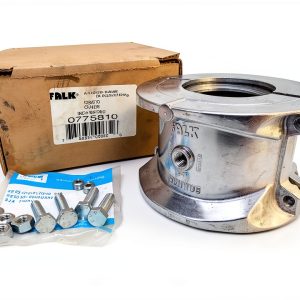
The Falk Flexible Grid Coupling operates on a simple but effective principle: a spring-like grid element engages with curved grooves in two metal hubs to transmit torque while accommodating misalignment. This design allows it to handle the three main types of misalignment—angular, parallel, and axial—while damping vibrations and absorbing shock loads that would otherwise damage motors, pumps, or driven equipment.
What sets the Falk coupling apart is its balance of flexibility and strength. The grid element acts as a mechanical spring that flexes under load, providing both the flexibility needed for misalignment and the resilience to handle sudden torque spikes. This is particularly valuable in applications like rock crushers or reciprocating compressors where shock loads are inevitable.
| Specification | Details |
|---|---|
| Design Type | Flexible Grid Coupling |
| Primary Function | Power Transmission with Misalignment Compensation |
| Key Feature | Spring Grid Vibration Damping |
| Typical Applications | Pumps, Conveyors, Compressors, Crushers |
| Maintenance Requirement | Periodic Lubrication Required |
| Key Advantage | Replaceable Grid Element Reduces Lifecycle Cost |
Real-World Performance & Feature Analysis
Design & Build Quality
The Falk coupling’s design hasn’t changed dramatically over the years because it works. The cast iron or steel hubs are typically well-machined with precisely cut grooves that engage the grid cleanly. I’ve installed dozens of these couplings, and the consistency in manufacturing is noticeable—the grids slide into place without excessive force, and the hubs mate smoothly with standard keyways.
What matters in practice: The quality of the groove machining directly impacts grid life. Poorly machined grooves create stress concentrations that can lead to premature grid failure. Falk’s manufacturing consistency here is generally excellent, which is why these couplings often outlast the equipment they’re installed on.
Performance in Real Use
Where the Falk coupling truly shines is in applications with variable loads. I recently retrofitted one onto a large water pump that was experiencing repeated bearing failures. The previous rigid coupling was transmitting every vibration directly to the pump bearings. After installing the Falk grid coupling, the vibration levels dropped noticeably, and we haven’t had a bearing failure in two years of continuous operation.
The trade-off: While excellent at damping vibrations, the grid coupling does introduce some torsional flexibility. This means there’s a slight wind-up under load that can affect positioning accuracy in applications requiring precise angular alignment. For most pump and conveyor applications, this isn’t an issue, but it’s critical to understand this limitation.
Ease of Installation & Maintenance
Installation is straightforward if you follow the proper procedure. The key is ensuring correct alignment before tightening the hubs. I’ve seen technicians try to use the coupling’s flexibility to compensate for poor initial alignment—this always leads to premature failure.
Maintenance reality: The lubrication requirement is both a pro and con. Proper lubrication extends grid life significantly, but it also requires discipline. In plants with poor maintenance practices, I’ve seen these couplings run dry until the grid fails. If your maintenance team struggles with scheduled lubrication, a maintenance-free alternative might be better.
Durability & Reliability
In a mining application I consulted on, Falk grid couplings on conveyor drives were lasting 3-5 years despite constant exposure to dust, moisture, and heavy shock loads from material impact. The replaceable grid design meant that when failure eventually occurred, we could replace just the grid element rather than the entire coupling, significantly reducing downtime and cost.
Failure mode awareness: These couplings typically fail gradually rather than catastrophically. The grid will show visible wear and increased flexibility before complete failure, giving maintenance teams warning signs. This predictable failure mode is a significant safety advantage over some coupling types that can fail suddenly.
Pros & Cons
Pros:
- Excellent vibration damping protects connected equipment from shock loads
- Proven durability in demanding industrial environments
- Cost-effective maintenance through replaceable grid elements
- Good misalignment capability for most industrial applications
- Predictable failure mode allows for planned maintenance
Cons:
- Requires periodic lubrication unlike some modern alternatives
- Not suitable for high-speed precision applications due to balance limitations
- Heavier and bulkier than some elastomeric couplings
- Grid replacement can be messy and time-consuming
Comparison & Alternatives
Cheaper Alternative: Standard Elastomeric Couplings
Elastomeric couplings (like basic jaw couplings) are typically cheaper upfront and require no lubrication. They’re lighter and often easier to install. However, they generally offer less torque capacity and poorer vibration damping. The elastomer element can degrade over time, especially in high-temperature or chemically aggressive environments.
When to choose: For light to medium-duty applications where cost is the primary driver and maintenance access is limited.
Premium Alternative: High-Performance Disc Couplings
Disc couplings offer zero backlash, higher speed capability, and often require no lubrication. They’re typically more compact and can handle greater misalignment. However, they’re significantly more expensive and may not provide the same level of vibration damping.
When to choose: For high-speed precision equipment, applications requiring absolute positioning accuracy, or where maintenance-free operation is critical.
Buying Guide / Who Should Buy
Best for Beginners
If you’re new to industrial power transmission, the Falk grid coupling is a reliable choice because of its forgiving nature and predictable performance. The installation process is well-documented, and the gradual failure mode gives you time to learn and respond to maintenance needs.
Best for Professionals
Experienced maintenance engineers will appreciate the Falk coupling’s serviceability and the ability to maximize lifecycle cost savings through proper maintenance. The ability to replace just the grid element rather than the entire coupling can significantly reduce long-term operating costs in large facilities.
Not Recommended For
Avoid this coupling if: You’re working with high-speed equipment (typically above 3600 RPM), require maintenance-free operation, need extreme misalignment capability, or are in a food-grade environment where lubrication could contaminate product.
FAQ
How often does the Falk grid coupling require lubrication?
Lubrication intervals vary by application but typically range from 3 to 12 months. High-temperature or heavily loaded applications require more frequent lubrication. Always follow the manufacturer’s recommendations for your specific operating conditions.
Can I install this coupling without precise alignment?
While the coupling can accommodate some misalignment, proper initial alignment is critical for long service life. Using the coupling to compensate for poor alignment will significantly reduce grid life and can lead to premature failure.
How do I know when the grid needs replacement?
Look for visible wear on the grid elements, increased vibration levels, or noticeable flexibility when hand-rotating the coupling. Regular inspection during lubrication is the best practice for catching wear early.
Is the Falk coupling worth the investment over cheaper alternatives?
For medium to heavy-duty applications where vibration damping and shock absorption matter, absolutely. The reduced equipment damage and longer service life typically justify the higher initial cost. For light-duty applications, a cheaper elastomeric coupling might suffice.
What’s the typical service life of these couplings?
With proper installation, alignment, and maintenance, Falk grid couplings can last 5-10 years in typical industrial applications. In particularly demanding environments, 2-3 years is more realistic, but the replaceable grid makes this manageable.