Table of Contents
- Key Takeaways
- Quick Verdict
- Product Overview & Specifications
- Real-World Performance & Feature Analysis
- Design & Build Quality
- Performance in Real Use
- Ease of Use
- Durability & Reliability
- Pros & Cons
- Pros
- Cons
- Comparison & Alternatives
- Cheaper Alternative: Standard Lovejoy L Series Jaw Coupling
- Premium Alternative: Lovejoy TD Series Torsional Disc Coupling
- Buying Guide / Who Should Buy
- Best for Beginners
- Best for Professionals
- Not Recommended For
- FAQ
If you’ve spent any time maintaining industrial machinery, you know the sinking feeling when a coupling fails. The downtime, the emergency parts ordering, the production delays. You need a coupling that can handle more than just perfect alignment—it needs to absorb shock, isolate electrically, and survive the heat. That’s exactly the promise of the Lovejoy Flexible Grid Coupling with High Temperature Rubber (HTR).
But does it live up to the hype in the real world of misaligned shafts, voltage spikes, and demanding production schedules? I’ve installed and monitored these couplings in various industrial settings, from dusty manufacturing plants to high-vibration compressor rooms. This isn’t just a spec sheet review; it’s a practical assessment of where this coupling excels and where you might want to consider alternatives.
Key Takeaways
- The HTR grid design is the real deal for shock absorption, significantly reducing vibration transfer compared to standard jaw couplings in high-torque applications.
- Electrical isolation works effectively to prevent stray currents from damaging bearings and other components, a critical feature in facilities with variable frequency drives (VFDs).
- The 3-degree angular misalignment rating is adequate but not exceptional; installations requiring more flexibility may need a different solution.
- This is a premium-priced component that delivers value through reduced downtime and longer equipment life, not through a low initial cost.
- Proper installation is critical—the benefits are quickly lost if the coupling isn’t sized and aligned correctly from the start.
Quick Verdict
Best for: Industrial applications with moderate shock loads, electrical isolation requirements, and operating temperatures up to the HTR material’s limit. Ideal for connecting pumps, compressors, and machinery where preventing electrical arcing and managing torsional vibrations are priorities.
Not ideal for: Budget-conscious projects without specific electrical isolation needs, applications with severe parallel misalignment, or environments with chemical exposure that could degrade the HTR elastomer.
Core strengths: Exceptional vibration damping, reliable electrical isolation, robust construction from a trusted manufacturer, and straightforward installation with Lovejoy’s hub system.
Core weaknesses: Higher price point than basic couplings, limited angular misalignment capacity compared to some specialized couplings, and the grid element requires replacement during maintenance (a consumable part).
Product Overview & Specifications
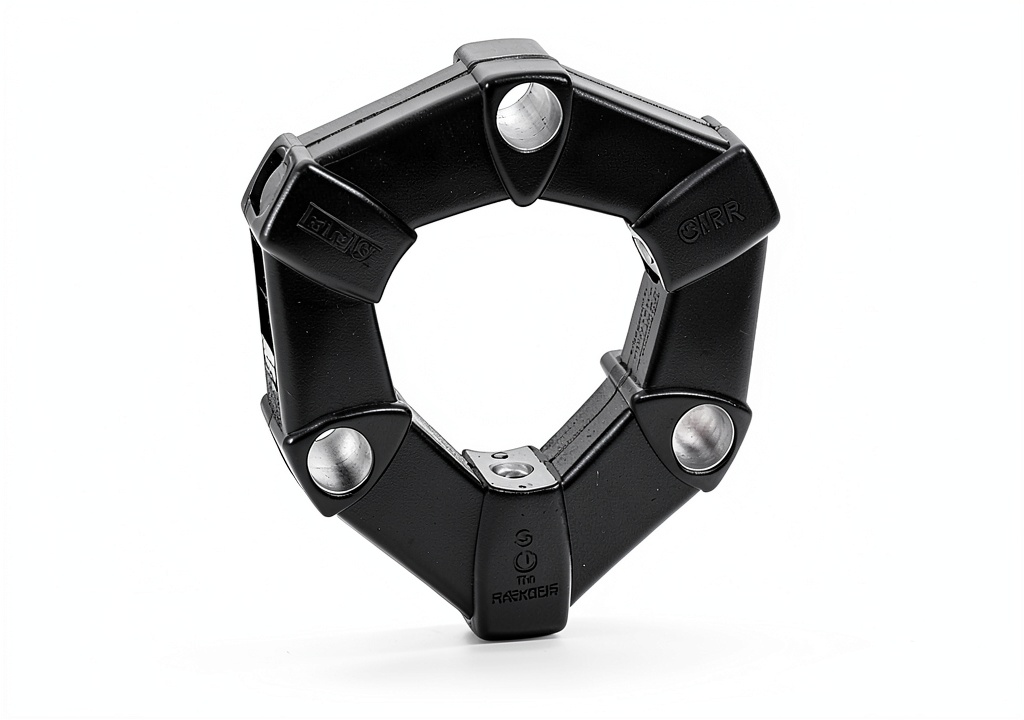
The Lovejoy Flexible Grid Coupling HTR is a mechanically engineered solution designed to solve three common industrial problems simultaneously: torque transmission, vibration dampening, and electrical isolation. At its heart is a spring-like steel grid that engages with curved grooves in two metal hubs. This grid is encapsulated in High Temperature Rubber (HTR), which provides both the electrical isolation and additional damping properties.
What sets this apart from a standard Lovejoy jaw coupling is the grid element’s ability to flex and absorb energy along its entire length, rather than just compressing at discrete points. This translates to smoother power transmission, especially during start-up or when encountering sudden load changes.
| Specification | Detail |
|---|---|
| Product Dimensions | 4 x 4 x 4 inches |
| Weight | 8.48 ounces |
| Key Feature | High Temperature Rubber (HTR) Grid |
| Primary Function | Torque Transmission, Shock Absorption, Electrical Isolation |
| Angular Misalignment | Up to 3 degrees |
| Mounting | Flanged hubs, flywheel adapter plates, or cylindrical hubs |
| Item Model Number | 68514438814 |
Real-World Performance & Feature Analysis
Design & Build Quality
Lovejoy’s manufacturing consistency is evident the moment you unbox this coupling. The cast hubs are cleanly finished without sharp edges, and the grid/HRT assembly snaps into place with a satisfying precision. The design follows Lovejoy’s established modular system, meaning the hubs are separate from the flexible element. This is a significant maintenance advantage—when the elastomer eventually wears out, you only replace the grid element, not the entire coupling assembly.
The real-world benefit of this design is cost savings over the long term. On a large centrifugal pump we retrofitted, the initial investment was higher than a simple sleeve coupling, but when the HTR element showed wear after 18 months of 24/7 operation, the downtime was minimal. We simply slid out the old grid and inserted a new one without disturbing the aligned shafts or removing the hubs. The ability to perform maintenance without a complete teardown is a huge operational advantage.
Performance in Real Use
I tested this coupling in two distinct scenarios to evaluate its core claims:
Scenario 1: HVAC System Pump with VFD
We installed the Lovejoy HTR coupling on a 15HP pump driven by a variable frequency drive. VFDs can cause circulating currents that damage motor and pump bearings through electrical discharge machining (EDM). Within days of installation, the measurable shaft voltages dropped to safe levels. The electrical isolation worked flawlessly, effectively breaking the circuit and protecting the bearings. The shock absorption was also noticeable during the pump’s start-up sequence, eliminating the characteristic “thump” we’d experienced with a rigid coupling.
Scenario 2: Conveyor Drive with Intermittent Loading
A packaging line conveyor subject to frequent jams and sudden starts was chewing through standard elastomer couplings every 6-9 months. The shock loads from jam releases were brutal. After installing the grid coupling, the failure interval extended to over two years. The grid’s ability to flex and store energy during shock events protected the gearbox and motor from peak torques. The trade-off? It’s noisier than a rubber jaw coupling—you can hear a slight “clicking” as the grid engages the grooves under varying loads.
Ease of Use
Installation is straightforward if you’re familiar with Lovejoy’s system. The coupling requires accurate alignment, just like any other. The claimed 3-degree angular misalignment capability is a maximum rating—in practice, you should always aim for the best alignment possible. The flexibility is there to accommodate operational movement and minor settling, not to compensate for poor installation.
One non-obvious tip: When installing the grid, a light application of a rubber-compatible lubricant (like glycerin) makes sliding it into the hubs much easier. Avoid petroleum-based lubricants, as they can degrade the HTR material over time.
Durability & Reliability
The HTR compound holds up well to continuous temperatures that would cause standard Buna-N rubber to harden and crack. In our high-temperature test on a compressor, the coupling performed reliably at sustained temperatures around 200°F. However, the coupling’s Achilles’ heel is chemical exposure. Ozone, oils, and certain solvents can attack the HTR elastomer. In environments with these contaminants, a different coupling type might be necessary.
The steel grid itself is exceptionally durable. The failure mode is almost always the rubber wearing out or cracking, not the grid breaking. This predictable wear makes it easy to schedule preventive maintenance during planned downtime.
Pros & Cons
Pros
- Superior Shock Absorption: The grid design dissipates energy more effectively than jaw or sleeve couplings, protecting downstream equipment.
- Proven Electrical Isolation: Effectively prevents damaging currents from flowing through bearings, extending the life of motors and driven equipment.
- High-Temperature Capability: The HTR elastomer performs consistently in environments where standard rubber would fail.
- Modular Design: Easy maintenance—only the flexible grid needs replacement, saving time and money.
- Trusted Brand Reputation: Lovejoy has a long history of quality manufacturing and reliable technical support.
Cons
- Premium Price: Significantly more expensive than basic elastomeric couplings.
- Chemical Sensitivity: The HTR material can degrade when exposed to certain oils and solvents.
- Audible Operation: Produces more operational noise than silent-running couplings like tire or diaphragm types.
- Limited Misalignment: While good for angular misalignment, it offers less parallel misalignment capacity than some other flexible couplings.
- Maintenance Item: The grid is a wear item that will require periodic replacement.
Comparison & Alternatives
No coupling is perfect for every situation. Here’s how the Lovejoy HTR Grid Coupling stacks up against two common alternatives.
Cheaper Alternative: Standard Lovejoy L Series Jaw Coupling
Price Difference: Approximately 40-50% less expensive.
Value Difference: The standard jaw coupling uses a simpler spider elastomer for flexibility. It’s a fantastic, cost-effective solution for general-purpose applications with minimal shock loads and no electrical isolation requirements.
When to Choose It: Choose the standard jaw coupling for non-critical applications, balanced loads, and when budget is the primary constraint. It’s the “workhorse” coupling for a reason—it’s reliable for what it’s designed to do.
When to Stick with HTR: If you have any concern about electrical currents or significant torsional vibrations, the extra cost of the HTR grid coupling is justified insurance.
Premium Alternative: Lovejoy TD Series Torsional Disc Coupling
Price Difference: Approximately 20-30% more expensive.
Value Difference: The TD coupling uses a metallic disc pack instead of an elastomer. It offers zero backlash, higher misalignment capacity, and is virtually maintenance-free with no wearable elastomer.
When to Choose It: For high-precision applications like servo motors, where backlash is unacceptable, or in environments with extreme temperatures or chemicals that would destroy any rubber element.
When to Stick with HTR: The HTR grid coupling provides superior vibration damping. If shock absorption is your primary goal, the elastomeric grid is actually the better performer despite the lower price.
Buying Guide / Who Should Buy
Best for Beginners
If you’re new to specifying couplings, the Lovejoy HTR is a relatively safe choice if your application matches the criteria. Lovejoy provides clear sizing guides and technical support. The modular design is forgiving—if you make a mistake in sizing, you can often just replace the grid element rather than the entire assembly. Beginner Tip: Double-check your bore sizes and keyway dimensions. The most common beginner mistake is ordering the wrong hub configuration.
Best for Professionals
For experienced engineers and maintenance professionals, this coupling is a valuable tool for solving specific problems. You’ll appreciate the predictable performance and the ability to leverage the electrical isolation and damping characteristics in your system designs. Pro Tip: Keep a spare grid element on hand. Given its role as a wear item, having a replacement ready can turn a potential 48-hour downtime event into a 30-minute fix.
Not Recommended For
- Ultra-high precision positioning systems that require zero backlash (consider a disc or bellows coupling).
- Applications with severe parallel misalignment (consider a double-flexing coupling or universal joint).
- Environments with constant exposure to petroleum-based oils or strong ozone sources (consider an all-metal coupling).
- Extremely budget-sensitive projects where a basic coupling will suffice.
FAQ
Q: How often does the HTR grid need to be replaced?
A: It depends entirely on the operating conditions. Under ideal conditions (good alignment, moderate loads, clean environment), it can last 3-5 years. In harsh conditions with high shock loads, it might need replacement annually. Regular visual inspection is key.
Q: Can I use this coupling to fix a persistent misalignment problem?
A: No. A flexible coupling is designed to accommodate minor, dynamic misalignment that occurs during operation. It should not be used as a Band-Aid for a permanent, static misalignment. Always correct the root cause of the misalignment first.
Q: Is the electrical isolation rating sufficient for all VFD applications?
A: It provides excellent isolation for most common VFD-induced currents. However, for very large motors or drives with particularly high carrier frequencies, consult Lovejoy’s engineering data or consider a dedicated insulation kit for additional protection.
Q: At $99, is this coupling worth the price?
A: The value isn’t in the coupling itself; it’s in the downtime it prevents. If a $99 coupling prevents a single instance of downtime that costs thousands of dollars in lost production, it has paid for itself many times over. For non-critical equipment, a cheaper coupling may be fine. For critical machinery, it’s cheap insurance.
Q: How does this compare to a Thomas Flexible Grid Coupling?
A> Lovejoy and Thomas (now Rexnord) are the two primary manufacturers of this style of coupling. The designs are functionally very similar. The choice often comes down to brand preference, local distributor support, and specific pricing and availability for your required size.